Commentary:
The goal of this task is to convert some fractions to decimals and then make conjectures about which fractions have terminating decimal expansions (as well as the length of those decimals). The teacher may wish to focus more on the conversion process and less on identifying which fractions have terminating or repeating decimal representations. In this case, only part (a) is needed and the key is that all remainders which appear in the long division algorithm are less than the divisor: this means that the decimal must either terminate (when there is a remainder of 0) or repeat (when we see the same non-zero remainder twice). The other parts of this task are looking forward to an additional level of structure, namely identifying which fractions have terminating decimals and which have repeating decimals.
The fractions on this list were deliberately chosen so that many of their decimal expansions will be familiar and will not require extensive calculation. The ones which will require work repeat or terminate quickly. At the teacher's discretion, a calculator could be used to help check work. It is important, however, for students to gain experience with the long division algorithm. Calculators also must be used with care as the only way to know for sure that a decimal is repeating is to perform the long division and see the same sequence of remainders cycling through over and over again.
Students who work on part (d) of this task should be encouraged to investigate their conjectures by testing more examples and, if they are ready, by thinking about the structure of the long division algorithm. Showing that these conjectures are true belongs to the eighth grade standards, 8.NS.1, but students can profitably reflect about this earlier. An explanation for the behavior of decimals examined here can be provided using properties of our base 10 system. A fraction $\frac{a}{b}$, in reduced form, has terminating decimal when $10^n×\frac{a}{b}$ is a whole number for some positive integer $n$. This means that $10^n×a$ is divisible by $b$. Since $a$ and $b$ share no common factor (other than 1) this means that $10^n$ must be divisible by $b$. The only prime factors of $10^n$ are 2 and 5 so this means that $b$ can only have prime factors of 2 and/or 5. This argument goes beyond the 7th grade standard and is more appropriate for the standard [standard 8.NS.A.1] but it is important for the teacher to be aware of this structure in case it comes up in discussion: some ideas along these lines are provided in the solution.
Solution:
1. We show the long division process on the most difficult of these fractions, namely $\frac{1}{12}$:
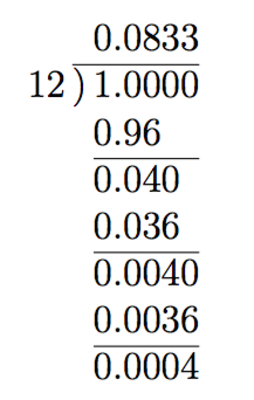
Notice that the remainder after subtracting $8×12$ (hundredths) is the same as the remainder after subtracting $3×12$ (thousandths), namely 4. This means that the 3 in the decimal repeats: we continue to take away 3 groups of 12 (in the ten thousandths place, hundred thousandths place, and so on) and the remainder is always 4. The decimal expansions of all of the fractions are listed below (those which repeat can be found in the same way as $\frac{1}{12}$ above and those which terminate are found when the long division process ends):
$$\begin{align} \frac{1}{2}&=0.5 \\ \frac{1}{3}&=0.\overline3 \\ \frac{1}{4}&=0.25 \\ \frac{1}{5}&=0.2 \\ \frac{1}{6}&=0.1\overline6 \\ \frac{1}{10}&=0.1 \\ \frac{1}{11}&=0.0\overline9 \\ \frac{1}{12}&=0.08\overline3 \\ \frac{1}{15}&=0.0\overline6 \end{align}$$
2. The fractions with terminating decimals on the list are:
$\frac{1}{2}, \frac{1}{4}, \frac{1}{5}, \frac{1}{10}$.
The only prime factors of the denominators for each of these fractions are 2 and/or 5.
Taking $\frac{1}{4}$ as an example, we can see where the terminating decimal comes from by observing that 4 is a factor of $100$: specifically we use the fact that $4×25=100$.
$$\begin{align} \frac{1}{4}&=\frac{1×25}{4×25} \\ &=\frac{25}{100} \\ &=0.25 \end{align}$$ The last equality comes from the fact that dividing by 100 moves the decimal two places to the left.
3. The fractions with repeating decimals on the list are:
$\frac{1}{3}, \frac{1}{6}, \frac{1}{11}, \frac{1}{12}, \frac{1}{15}$
Each of these fractions has a prime factor different from 2 or 5 in the denominator: 3, 6, 12, and 15 have a prime factor of 3 and 11 has a prime factor of 11. Unlike in the cases in part (b), multiplying by a power of 10 will never result in a whole number here because a factor of 3 or 11 will always remain in the denominator. This means that the decimals do not terminate.
4. The examples studied here indicate that a pattern of a decimal expansion is determined by the denominator (though different numerators should be tried to see if the 1 in the numerator of all of these fractions plays an important role). When the only prime factors of the denominator are 2 and 5 the decimal terminates. When the denominator has a prime factor other than 2 or 5 the decimal eventually repeats. More work would be necessary to see if this always holds: this would mean looking at more fractions with different numerators and denominators and eventually thinking carefully about the division algorithm.