Commentary
The goal of this task is to compare fractions with a focus on providing explanations that demonstrate deep conceptual understanding. The main comparison techniques to look and listen for (for non equivalent fractions) are
- Using a common numerator (e.g. thirds are bigger than fourths, so two thirds are bigger than two fourths).
- Using a common denominator (e.g. $\frac{1}{5}$ is less than $\frac{2}{5}$ because there is an extra fifth of a whole in $\frac{2}{5}$).
- Using a whole as a benchmark (e.g. $\frac{2}{3}$ is less than $\frac{5}{4}$ because $\frac{2}{3}$ is less than $\frac{3}{3}$ or one whole and $\frac{5}{4}$ is larger than $\frac{4}{4}$ or one whole).
Concerning the third method, using a benchmark to compare two fractions is explicitly mentioned in [standard 4.NF.2]. Because the meaning of a whole is fundamental to understanding a fraction, it is appropriate to use 1 as a benchmark in the third grade. The teacher may, however, choose to remove those cards containing pairs of fractions where one is larger than a whole and the other is less than a whole.
Two different sets of cards are provided as attachments, one with a picture of the two fractions being compared and one without. The pictures allow students to make a visual comparison of the fractions which is important. However, the teacher may wish for students to provide these pictures as one means of explaining their decision. Similarly, the teacher may also wish to remove cards having equivalent fractions if the goal is to work exclusively on inequalities.
Question 2 is intended to motivate a classroom discussion after students have completed the activity. In order to better prepare them for this, the teacher may suggest that students think about the strategies they are using to compare fractions as they play the game. Some methods, like drawing pictures or using fraction strips, can be used for all of the pairs of fractions. But other methods such as looking for a common numerator and common denominator are conceptually important and the teacher will want to make sure that these methods are discussed.
Solution
a. There are four types of fractions which students will need to compare:
- Fractions having the same numerator. The denominator tells us how many equal pieces are in the whole, determining the size of each piece, and the numerator tells us how many of those pieces we have. For example, to compare and , there are more fifths in the whole than thirds so fifths are smaller. This means that $\frac{2}{5} < \frac{2}{3}$.
- Fractions having the same denominator. For example, we see that $\frac{2}{3} > \frac{1}{3}$ because $\frac{2}{3}$ is $\frac{1}{3}$ and an additional third so it is bigger. This relates to the reasoning described in the common numerator situation: the denominator tells us there are the same number of pieces in the whole, however one fraction has more of those pieces than the other.
- One fraction is less than 1 and the other fraction is larger than 1. For example,$\frac{2}{3} < \frac{3}{2}$ because $\frac{2}{3}$ is one third short of a whole while $\frac{3}{2}$ is an entire whole with an additional half added.
- Simple equivalent fractions such as $\frac{1}{2}$ and $\frac{2}{4}$. One way to show that these fractions represent the same quantity is with a picture:
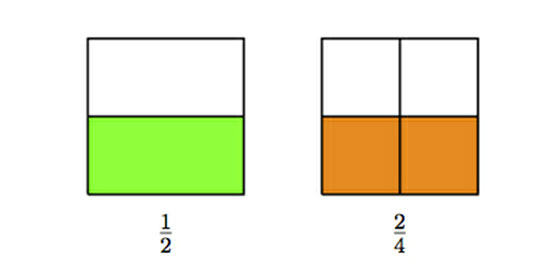
Here the two large squares are equally sized wholes which have been divided into two equal parts (on the left) and four equal parts (on the right). The same fraction of the whole is shaded in each picture so $\frac{1}{2}$ is equivalent to $\frac{2}{4}$.
b. There are many important lessons to be learned from comparing these fractions including:
- If I draw a picture of the two fractions, the larger fraction will have more shaded than the smaller fraction. If the two fractions are equal, the same amount will be shaded in both.
- The denominator tells me how many pieces to cut my whole into. When the whole is cut into more pieces, the pieces are smaller (this is why $\frac{1}{3}$ is less than $\frac{1}{2}$).
- The numerator tells me how many equal sized pieces I have. So $\frac{3}{5}$ is more than $\frac{2}{5}$ because I have one extra piece.
- Fractions are built from the unit fractions so it is important to understand and be able to represent the unit fractions.
- If using the fraction cards with pictures, equal sized wholes are important when comparing fractions.
- Equivalent fractions have different sized pieces, but the same total amount shaded.
- When the numerator is a bigger number than the denominator, the fraction is greater than one whole.
- When doing mathematics, patterns emerge. These patterns support students in making conjectures, supporting their reasoning, and proving mathematical claims.


